

Struggling with complex split product costs? Inaccurate numbers silently eat into your profits, making it hard to price correctly and stay competitive in a tight market.
Accurate costing for split products involves two main methods. Special segmentation offers high precision by tracking costs for complex, individual products. Quota allocation is a simpler method that assigns costs based on predefined ratios. The best choice depends on your operational complexity and need for detail.
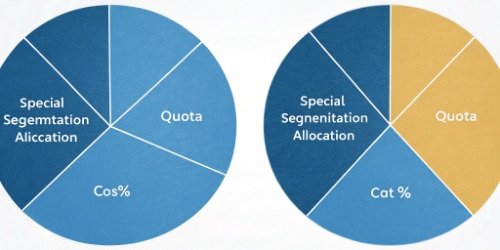
Understanding these methods is the first step. But the real question is how to apply them effectively in a busy production environment, especially when dealing with diverse and complex product lines. As a manufacturer of industrial scales for 19 years, I've seen firsthand how crucial this is. Let's break it down further to see which one fits your business and how the right technology can make it seamless.
What Are the Key Differences Between Special Segmentation and Quota Allocation?
Confused by costing jargon? Choosing the wrong method can lead to misleading financial reports and poor business decisions, directly impacting your bottom line.
The main difference is precision versus simplicity. Special segmentation tracks costs for each specific product variant, like an organic cut. Quota allocation uses a standard formula to distribute costs across all resulting products, often assigning costs by weight or market value.

Let's dive deeper into what sets these two approaches apart. In my experience working with hundreds of clients, the choice isn't about which method is universally "better," but which one is strategically smarter for your specific operation. Think of it this way: special segmentation is like giving each diner a separate check for exactly what they ordered. Quota allocation is like splitting the total bill evenly among everyone at the table. Both methods get the bill paid, but one provides much more detail. Special segmentation is ideal for high-value, distinct items where knowing the precise cost is critical for pricing.1 Quota allocation is faster and sufficient when the end products are similar in value and cost structure. Here is a simple breakdown:
| Feature | Special Segmentation | Quota Allocation |
|---|---|---|
| Precision | High; tracks costs per item | Lower; averages costs |
| Complexity | High; requires detailed tracking | Low; uses simple formulas |
| Best For | Premium, varied products | Homogeneous, bulk products |
| Data Needs | Extensive; SKU-level data | Minimal; total weights/values |
Understanding these fundamental differences is the first step toward gaining true control over your production costs.
Which Method Works Best for Your Split Product Costing Needs?
Choosing a costing method feels like a big commitment. Making the wrong choice can create unnecessary work for your team or, worse, hide costly inefficiencies in your process.
For simple, uniform production, quota allocation is efficient and straightforward. For businesses with premium lines, diverse sources, or complex packaging, the precision of special segmentation provides the necessary insights to protect margins and ensure accurate pricing for each unique product.

So, how do you decide? After years of helping companies optimize their weighing and costing processes, I've learned that the answer often lies in the products themselves. The more variation you have, the more you need a detailed costing approach. If your process involves turning one raw material into several very different end products, you need to understand the cost journey of each one. Here’s a quick guide to help you choose the right path for your business.
Use Special Segmentation If...
You should lean towards special segmentation if your operation involves any of the following. This method justifies the extra effort by providing clarity on your most profitable (or unprofitable) items.
- You Handle Premium and Standard Products: You need to separate the costs for organic or high-welfare pork from standard pork to ensure your premium pricing is justified and profitable.
- You Use Mixed Sources: You source both imported and domestic meat and need to track their distinct costs through the entire splitting process.
- You Use Complex Packaging: Products like modified atmosphere packs (MAP) or combination packs have additional costs that shouldn't be spread across your bulk items.
Use Quota Allocation If...
Quota allocation is still a very valid and efficient method in the right context. Consider it if your business fits this profile:
- Your Output is Homogeneous: If you are splitting a carcass into primal cuts that have similar value and processing requirements, a simple weight-based allocation can be sufficient.
- Speed is More Critical than Pinpoint Accuracy: In very high-volume, low-margin operations, the speed of quota allocation may outweigh the benefits of more detailed tracking.
- You Have Limited Tracking Capabilities: If you don't yet have systems in place to track each item individually, quota allocation provides a workable starting point for cost control.
Ultimately, the goal is clarity. Choose the method that gives you the clearest picture of your costs so you can make the smartest business decisions.
How Can a System Handle Complex Scenarios Like Mixed Sources and Packaging?
Manual tracking is impossible for complex modern operations. Spreadsheets inevitably break, data gets lost, and your real costs remain a complete mystery, leaving you guessing on pricing.
A modern weighing system integrates directly into your workflow to automate this process. It allows you to define rules for different product types, automatically applying the correct costing method—whether special segmentation for a high-value cut or quota allocation for bulk items.

From my 19 years in this industry, I know these pain points well. Manually assigning costs for different sources—like imported versus domestic meat, or organic versus conventional pigs—is a nightmare. Adding in different packaging types, like bulk, MAP, or combo packs, makes it exponentially harder. That’s why we built our WeigherPS system to be flexible and powerful enough to handle it all automatically. The key is giving the user control to define the logic. Our system allows you to set up multi-dimensional costing rules. You can create rules that tell the system to calculate costs based on product origin (e.g., "Imported") or packaging type (e.g., "MAP"). This means a single raw material input can have its costs split accurately across dozens of different final SKUs. The system can apply a specific segmentation rule for a high-value organic cut while simultaneously using a simple weight-based quota allocation for the trim.2 This fine-grained control, right down to the individual SKU, is what allows businesses to achieve truly precise cost management and build intelligent pricing strategies.
Conclusion
Choosing the right costing method and using a system that can automate it is essential for profitability and growth in the competitive food processing industry.
-
"High-Value Customer Segments: Unlocking Business Growth and ...", https://luthresearch.com/glossary/high-value-customer-segments-unlocking-business-growth-and-strategy/. This source discusses the suitability of special segmentation for high-value, distinct items and its impact on pricing accuracy. Evidence role: mechanism; source type: education. Supports: Special segmentation is ideal for high-value, distinct items where knowing the precise cost is critical for pricing.. ↩
-
"Customer segmentation, allocation planning and order promising in ...", https://link.springer.com/article/10.1007/s00291-008-0123-x. This source explains how systems can apply different costing rules simultaneously for varied product types. Evidence role: mechanism; source type: education. Supports: The system can apply a specific segmentation rule for a high-value organic cut while simultaneously using a simple weight-based quota allocation for the trim.. ↩


Comments (0)