
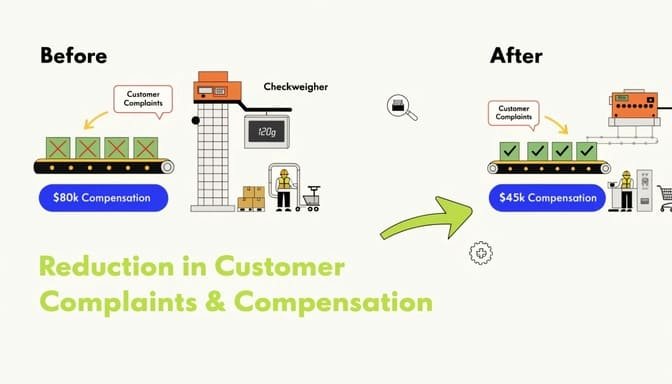
Tired of costly customer complaints about product weight? These issues can damage your brand and your bottom line. A checkweigher is the simple, effective solution you need.
Adding a checkweigher can drastically reduce weight-related customer complaints and compensation costs, often by over 90%. By ensuring every product meets its stated weight, you eliminate the primary cause of these expensive issues and protect your brand's reputation.
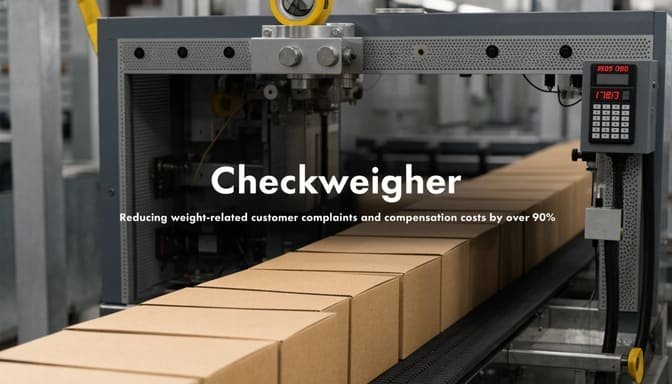
This might seem like a bold claim, but my 19 years in the weighing industry have shown me just how powerful this one change can be. I have seen firsthand how a single, unresolved customer complaint about product weight can spiral into significant costs, not just in refunds but in lost reputation. On the other hand, I've seen companies transform their quality control almost overnight. Let's break down how this small investment delivers such a massive return and what it means for your business's bottom line.
How much can adding a checkweigher during packaging reduce customer complaints and compensation costs?
Are customer complaints about incorrect weights eating into your profits? The constant need for refunds and replacements is frustrating for you and your customers. An automated checkweigher can stop these issues at the source.
Implementing a checkweigher can nearly eliminate customer complaints and compensation claims related to product weight. The initial investment is often recovered quickly, as the cost of handling just one complaint can exceed the price of the machine itself.
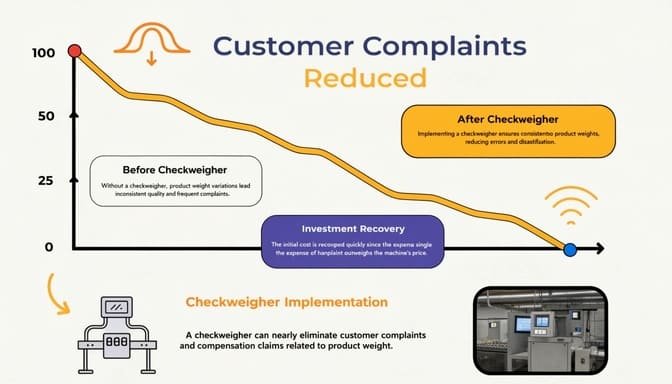
In my experience, many of our clients, especially software vendors who need to ensure hardware compatibility and reliability, initially focus only on the ticket price of the equipment. But they quickly learn the true value is in the problems it solves. The cost of a single weight-related customer complaint isn't just the price of the product.1 It includes shipping for the return and replacement, the labor cost of your customer service team, and the hardest cost to measure: damage to your reputation. Unhappy customers often share their bad experiences2, which can deter many potential future buyers. When you compare these recurring, unpredictable expenses to the one-time cost of a checkweigher, the return on investment (ROI) becomes clear. In some cases, the payback period can be just a few months3.
The True Cost of One Complaint vs. The Investment
| Cost Factor of a Complaint | Checkweigher Solution |
|---|---|
| Refund or Replacement Product Cost | Prevents underfilled packages from being shipped. |
| Shipping & Handling (Return & New Shipment) | Eliminates the need for weight-related returns. |
| Customer Service Labor Time | Frees up staff from handling preventable issues. |
| Damage to Brand Reputation & Lost Future Sales | Builds customer trust through proven consistency. |
| Total: Potentially hundreds or thousands per incident | One-time investment with rapid ROI. |
What impact does implementing a checkweigher in the packaging process have on product discrepancies?
Are manual weight checks leading to inconsistent product weights and quality control issues? This reliance on human intervention introduces errors and hurts your brand. Automated checkweighing ensures precision for every single item.
A checkweigher has a massive impact by ensuring 100% weight inspection on your production line. It automatically identifies and rejects any under- or overweight products, virtually eliminating product discrepancies before they can ever leave your factory.
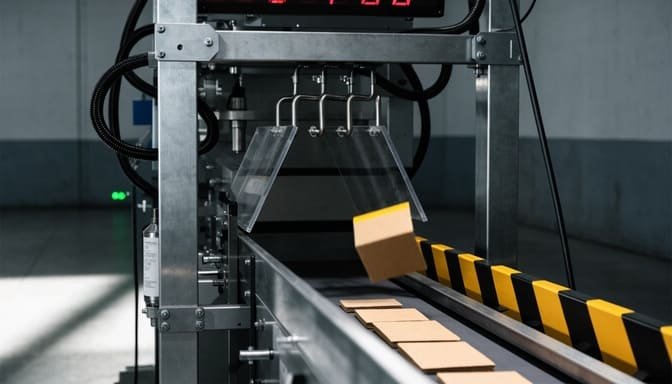
Let's dive deeper into how this works on a practical level. A checkweigher isn't just a scale; it's an intelligent quality control gatekeeper. As your products move down the conveyor belt, each one passes over a highly sensitive load cell that weighs it in motion4. This data is instantly compared against your preset acceptable weight range. Any package that is even slightly off is immediately removed from the line5 by a rejection device. This process is seamless and happens at high speeds, ensuring your production efficiency isn't compromised.
From Manual Error to Automated Precision
- The Flaw of Manual Spot-Checking: Relying on operators to manually pull a few items for a weight check is fundamentally flawed.6 It's not a 100% check, and it's subject to human error and inconsistency. A checkweigher inspects every single product.7
- How 100% Automated Inspection Works: By integrating directly into your line, the checkweigher automates the entire inspection process. This guarantees that no product is missed and that the standards are applied consistently 24/7.
- Data for Process Improvement: Modern checkweighers, especially our IoT-enabled models, provide valuable production data. As a software provider, you'll appreciate this. You can track trends, see average weights, and count rejection rates. This data helps pinpoint upstream issues—like a faulty filler8—allowing you to fix problems at their root, saving even more money and improving overall efficiency.
Can the introduction of a checkweigher in packaging improve customer satisfaction and reduce financial losses?
Worried that unhappy customers are hurting your brand reputation? Negative reviews from simple weight errors can cause significant financial damage and erode trust. A checkweigher helps protect both your customers and your profits.
Absolutely. A checkweigher directly boosts customer satisfaction by guaranteeing they receive exactly what they paid for. This consistency builds trust and brand loyalty, which in turn prevents financial losses from complaints, refunds, and brand damage.
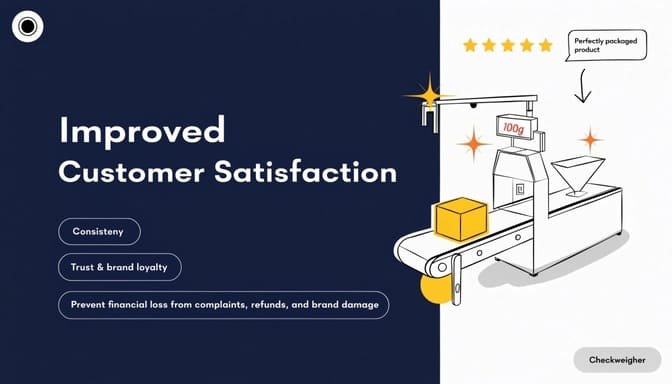
From my perspective as a manufacturer, your customer's experience is everything. When a customer receives a product that feels lighter than expected, their trust in your brand immediately falters. It suggests a lack of quality control. A checkweigher solidifies this trust. Every time a consumer receives a perfectly filled package, their confidence in your brand is reinforced. This is especially critical for our clients who are software service providers; the hardware you integrate with reflects on your software's reliability. Beyond customer goodwill, checkweighers also prevent financial losses in less obvious ways. Many regions have strict weights and measures regulations. Shipping underfilled packages can lead to hefty fines, while overfilling—or product giveaway—eats away at your profits over time. A checkweigher helps you navigate this perfectly.
Building Value Beyond Just Weight
- Building Trust Through Consistency: Consistency is the foundation of a strong brand reputation. By delivering the correct amount every single time, you meet customer expectations and foster loyalty.
- Avoiding Regulatory Fines: Under-filling products can violate trade and consumer protection laws.9 A checkweigher ensures you are compliant, protecting you from potentially costly legal issues.
- Protecting Your Bottom Line: Over-filling, even by a small amount, adds up to significant financial loss over millions of units.10 A checkweigher optimizes material usage and maximizes your product yield, improving your profitability.
How effective is using a checkweigher in minimizing errors and preventing customer compensation claims?
Are preventable errors on the packaging line costing you a fortune in compensation? Manual checks simply aren't enough to catch every mistake. A checkweigher provides a reliable, automated safety net.
A checkweigher is extremely effective, acting as a final quality control gatekeeper. By physically removing incorrectly weighted packages from the line, it proactively minimizes errors to nearly zero, directly preventing the customer compensation claims that result.
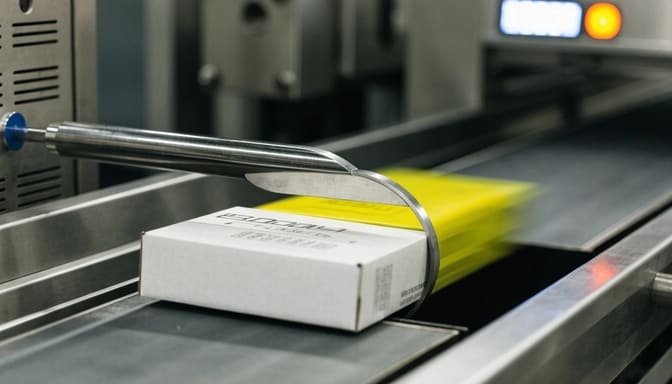
The key here is the automated removal of faulty products. A checkweigher doesn't just flag an error; it acts on it. After an underweight or overweight package is detected, a signal is sent to an integrated rejection system. These systems are designed to remove the offending package from the production line without stopping the flow. This physical prevention is what makes a checkweigher so much more effective than a simple alarm or manual process. As a company dedicated to quality assurance, we test every single one of our scales before it ships, because we understand that our clients need a system they can trust to protect their own quality standards. Your checkweigher is the last line of defense before your product reaches the customer, and making that defense automated and physical is the most effective strategy.
Choosing the Right Rejection Method
| Rejection Method | Description | Best For |
|---|---|---|
| Pusher Arm | A pneumatic arm gently pushes the package sideways off the line. | Boxes, cartons, and other rigid containers. |
| Air Blast | A strong puff of compressed air blows the item off the conveyor. | Lightweight items like bags, packets, and pouches. |
| Flipper/Diverter | A gate pivots to divert the item onto a separate lane or drop it. | High-speed lines or sorting applications. |
Conclusion
A checkweigher is not a cost; it is a powerful investment in quality, efficiency, and reputation. It directly cuts complaints, stops financial loss, and builds customer trust, securing your long-term growth.
-
"Recover From Failure: Examining the Impact of Service ... - PMC", https://pmc.ncbi.nlm.nih.gov/articles/PMC9014211/. Customer complaint management research supports that complaints can impose direct handling costs and indirect costs such as customer dissatisfaction and lost future business, although it may not isolate weight-related complaints specifically. Evidence role: general_support; source type: paper. Supports: A product-weight complaint can create costs beyond the replacement value of the product.. Scope note: The evidence is likely to address complaint costs generally rather than packaging-weight complaints alone. ↩
-
"Effects of Negative Online Word-of-Mouth on Consumer ...", https://scholarworks.uno.edu/cgi/viewcontent.cgi?article=1079&context=honors_theses. Research on negative word of mouth and online reviews supports that dissatisfied customers may communicate adverse experiences to others, influencing reputation and purchasing behavior; it is contextual evidence rather than proof for this specific product category. Evidence role: expert_consensus; source type: paper. Supports: Unhappy customers often share negative experiences, which can harm reputation and deter future buyers.. Scope note: The finding is general to consumer behavior and may vary by market, product type, and complaint severity. ↩
-
"A Robust Technique to Perform Product Quality Inspection", https://scholarworks.utrgv.edu/cgi/viewcontent.cgi?article=1947&context=etd. Manufacturing automation and quality-control ROI studies can support that defect-prevention investments may have short payback periods when scrap, returns, and rework are reduced, but they would not establish a universal payback period for all checkweigher installations. Evidence role: statistic; source type: paper. Supports: In some cases, a checkweigher investment can pay back within a few months.. Scope note: Payback depends on line speed, defect rate, product value, labor costs, and regulatory exposure. ↩
-
"In-Motion Checkweighers", https://www.ricelake.com/product-landing-pages/in-motion-checkweighers. Technical material on dynamic weighing and load cells supports that checkweighers commonly use load-cell-based weighing sections to measure items while they move through a conveyor system. Evidence role: mechanism; source type: education. Supports: Checkweighers commonly use load cells to weigh products in motion on a conveyor.. Scope note: Specific sensor design varies by manufacturer and application, so the source would support the common mechanism rather than all checkweighers universally. ↩
-
"Principles of Checkweighing", https://www.packagingstrategies.com/ext/resources/FDP/Home/Files/PDF/PrinciplesofCheckweighing.pdf. Standards and technical descriptions of automatic checkweighing support that products outside preset tolerances can trigger rejection devices, although the exact rejection threshold and immediacy depend on system settings and line conditions. Evidence role: mechanism; source type: institution. Supports: Checkweighers can identify packages outside a preset weight range and trigger their removal from the production line.. Scope note: The evidence supports the operating principle, not the performance of every installation under all speeds or product formats. ↩
-
"Quality Inspection Task in Modern Manufacturing", https://digitalcommons.unl.edu/cgi/viewcontent.cgi?article=1010&context=imsefacpub. Sampling-inspection and statistical quality-control literature explains that spot checks inspect only a subset of production and can miss defects between samples, supporting the limitation of manual sampling compared with continuous inspection. Evidence role: mechanism; source type: education. Supports: Manual spot-checking can miss incorrectly weighted products because it is not continuous inspection.. Scope note: The source would support the statistical limitation of sampling, not necessarily characterize all manual checks as flawed in every context. ↩
-
"Check weigher", https://en.wikipedia.org/wiki/Check_weigher. Definitions of automatic catchweighing instruments describe systems that weigh discrete loads in motion on a production line, supporting the claim that inline checkweighers can perform unit-by-unit weight checks when installed for full-flow inspection. Evidence role: definition; source type: institution. Supports: An inline checkweigher can inspect each product passing through the production line.. Scope note: The statement is accurate only when all products pass through the checkweigher and the device is correctly configured and maintained. ↩
-
"Process monitoring using causal map and multivariate ...", https://web.mit.edu/braatzgroup/54_Process_monitoring_using_causal_map_and_multivariate_statistics_fault_detection_and_identification.pdf. Statistical process control literature supports using process measurements and trend data to detect variation and identify upstream causes of defects, though it does not prove that checkweigher data alone will diagnose every filler fault. Evidence role: mechanism; source type: paper. Supports: Checkweigher weight data can help identify upstream process problems such as filler drift or faults.. Scope note: The evidence is contextual because root-cause identification may require additional process data and investigation. ↩
-
"Checking the Net Contents of Packaged Goods", https://www.nist.gov/system/files/documents/2023/02/10/2023%20NIST%20Handbook%20133.pdf. Weights-and-measures laws and net-content inspection handbooks establish that packaged goods are regulated for declared quantity and that underfilled packages can be noncompliant, supporting the legal-compliance aspect of the claim. Evidence role: historical_context; source type: government. Supports: Underfilled packages can violate weights-and-measures or consumer-protection requirements.. Scope note: Penalties and enforcement procedures vary by jurisdiction and product category. ↩
-
"Cost of goods sold and total cost of delivery for oral and ... - PMC", https://pmc.ncbi.nlm.nih.gov/articles/PMC5844852/. Packaging and process-control literature on fill-weight variation supports that systematic overfill creates cumulative product giveaway costs across high-volume production, although the financial magnitude depends on product value and production volume. Evidence role: mechanism; source type: paper. Supports: Small average overfills can accumulate into significant material cost losses in high-volume production.. Scope note: The source would support the economic mechanism, not a specific loss amount for this article’s readers. ↩


Comments (0)