
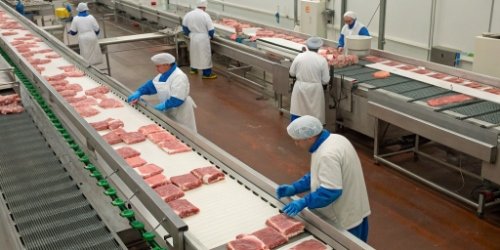
Losing meat and money between the carcass cooler and the cutting line? This inefficiency creates untraceable products and costs you profits. A smart, integrated system is the answer.
The best method is to implement a system that combines barcode scanning with precise weighing. This approach automatically links carcass data to the cutting line, calculates material loss in real-time, and guarantees full traceability from receiving to final product, ensuring data accuracy and operational efficiency.
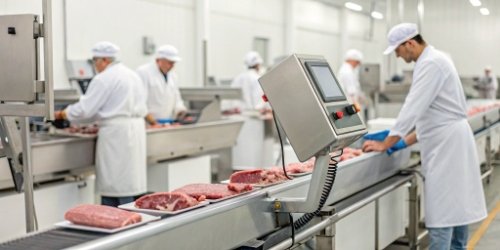
Getting the initial weighing and material distribution right is the foundation of a profitable meat processing operation. An error at this first step can cause major problems down the line, affecting your yield calculations, inventory accuracy, and profit margins1. But how can you ensure this critical process is foolproof? Let's break down the key aspects of managing material distribution in your cutting and weighing process. It's more straightforward than you might think when you have the right tools.
How to Manage Cutting, Weighing, and Material Distribution in Meat Processing?
Struggling to connect carcass inventory to the cutting line? Manual tracking leads to errors, waste, and a lack of accountability. You need a better way to manage this crucial link.
The key is a system that supports both simple scan-to-receive and detailed scan-and-weigh methods. This provides flexibility while capturing precise data at the point of distribution, linking everything automatically for you.
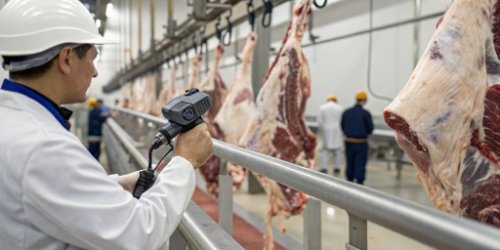
This initial distribution point is a critical link between your cold storage (the "white carcass library" as we sometimes call it) and the cutting production line. Managing it effectively is not just about moving meat; it's about moving data accurately. At Weigherps, we have designed our systems to provide flexibility and control at this stage. You can choose the method that best fits your operational needs.
The Scan-to-Receive Mode
This is the simpler, faster option. An operator uses a scanner to read the barcode on a carcass or a crate of meat. The system instantly records that this specific item has been moved from storage to the cutting line. This mode is excellent for high-throughput environments where speed is essential and the items have a relatively standard or pre-assigned weight. It establishes a basic level of traceability—knowing what went to the line and when—without capturing the exact weight at that specific moment.
The Scan-and-Weigh Mode
This mode offers a higher level of precision. The operator scans the item, which is then immediately weighed on an integrated scale. The system captures both the ID and the exact weight. The most powerful feature here is the ability to automatically calculate loss. For example, if a crate of meat is weighed, the system can subtract the tare weight of the crate and record the net meat weight. It can also compare this weight to a previous measurement to calculate any loss (like drip loss) that occurred in storage, giving you incredibly valuable data for process improvement.
What Is the Best Approach for Handling Weighing and Material Allocation in Cutting Workshops?
Are unreliable weight readings throwing off your entire production plan? If your starting data is wrong, everything that follows will be inaccurate. This is a common and extremely costly problem.
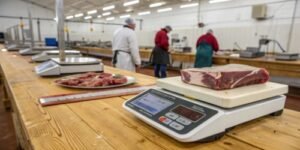
The best approach is to enforce data accuracy at the source. Use a smart system with static rail scales that prevents operators from saving unstable weight readings, guaranteeing a reliable baseline for all processes.

The old saying "garbage in, garbage out" has never been more true than in meat processing. The initial weight of the carcass you issue to the cutting line is the single most important number for calculating your production yield. If that number is wrong, every single report, from yield analysis to profitability per carcass, will be wrong. I remember visiting a client's facility years ago. Their team was rushing, and they were recording weights from the rail scale while the carcasses were still swinging. Their yield data was all over the place, and they couldn't figure out why their profits weren't matching their production numbers.
Why Stable Weight Readings Are Critical
A swinging carcass, vibrations from nearby equipment, or an unsettled scale can all lead to fluctuating, inaccurate readings. An operator in a hurry might just write down the first number they see. This single point of human error can have a ripple effect throughout your entire system, making it impossible to accurately track efficiency or pinpoint sources of loss.
How Our Technology Enforces Accuracy
We solved this problem by removing the possibility of human error2. Our system creates a direct link between the scale and the software interface. The software continuously monitors the weight signal from the scale. It is programmed to only enable the "Save" or "Confirm" button when the scale's reading has remained stable within a predefined tolerance (e.g., +/- 0.05 kg) for a set period (e.g., 2 seconds). This simple rule ensures that only true, stable, and accurate weights are ever entered into the system3.
| Feature | Manual or Basic System | Weigherps Integrated System |
|---|---|---|
| Data Entry | Operator can enter any value | System locks until weight is stable |
| Accuracy | Prone to rush and human error | High, based on verified stable readings |
| Result | Inaccurate yields, skewed cost analysis | Reliable baseline, true profit reports |
How Can Cutting and Weighing Processes Be Streamlined for Efficient Material Use?
Juggling spreadsheets and paper trails to track meat from receiving to the cutting line? This disconnect is inefficient and leaves your operation vulnerable to untraced losses and errors.
Streamline your process by using a system that automatically links material receiving data with the subsequent cutting and production data. This creates a single, unbroken chain of information, providing full traceability and eliminating manual entry.
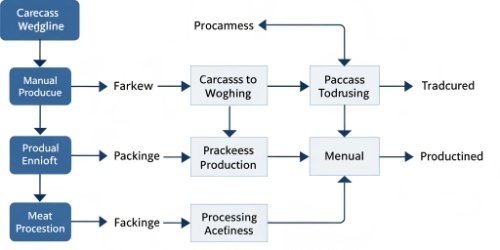
Efficiency in a cutting workshop comes from a smooth, continuous flow of both materials and information. When your information flow is broken or relies on manual steps, the entire process slows down, and mistakes happen. The real goal is to make the data follow the meat automatically, creating a digital twin of your physical process. This is exactly what we achieve by linking all the data points together.
The Power of Automatic Data Association
Imagine a carcass with ID '123' is issued from the cooler. It's scanned and weighed on the rail scale, creating a digital record: ID: 123, Type: Carcass, Weight: 200 kg, Time: 08:05. This carcass then moves to a cutting station. As the butchers create primal cuts, each cut is placed on a scale, weighed, and labeled. The system links each new item back to the original source. For example:
ID: 123-Loin, Type: Loin, Weight: 15 kg, Source_ID: 123ID: 123-Ribs, Type: Ribs, Weight: 20 kg, Source_ID: 123
The system automatically knows that the loin and ribs came from carcass 123. This happens for every cut, all the way down to trim. At the end, the system can provide a full mass-balance report for carcass 123, accounting for every gram.
The Critical Importance of Full Traceability
This automatic linking does more than just improve efficiency. It provides the end-to-end traceability that is essential in the modern food industry4. If you ever have a quality or safety issue with a specific batch of final product, you can instantly trace it back. With a few clicks, you can identify the exact carcass it came from, the date it was processed, the supplier it came from, and what other products were made from that same carcass. This capability is not a "nice-to-have"; it is a fundamental requirement for our clients serving markets in Europe and North America, and our systems are built to meet these exacting standards.
What Are the Key Steps for Implementing a Cutting and Weighing Material Distribution System?
Thinking about upgrading your system seems overwhelming? The perceived complexity of integrating new hardware, software, and training your team can make you hesitate. But it doesn't have to be a difficult process.
A successful implementation involves four key steps: assessing your current workflow, selecting the right hardware, integrating the software, and training your team. A good partner will guide you through each stage to ensure a smooth transition.

Over my 19 years in this industry, I've seen that the most successful technology rollouts are the ones that are planned as a partnership. As your weighing expert, our job is not just to sell you a scale; it's to provide a complete solution that makes your business more profitable and efficient. We break down the implementation into manageable phases, ensuring you feel confident and supported at every step.
Phase 1: Assessment and Planning
This is the most important step. We don't start by talking about products; we start by listening. We work with your team—your purchasing managers, technical directors, and production floor supervisors—to understand your specific process. We map your material flow, identify your biggest pain points, and define what success looks like for you. This allows us to tailor a solution that is targeted, cost-effective, and directly addresses your individual needs.
Phase 2: Hardware and Software Integration
Based on the plan, we help you choose the right tools for the job. This might include heavy-duty static rail scales, washdown-safe bench scales for cutting stations, rugged handheld scanners, and industrial touch-screen terminals. Our technical team then gets to work. They ensure all the hardware components communicate seamlessly with each other and with the central software, whether it's our own or a system you already use. We specialize in making technology work together.
Phase 3: Testing and Training
Before the system goes live, we test every aspect of it in your environment to ensure it works exactly as planned. Then, we focus on your people. We provide comprehensive training for your operators, supervisors, and managers. Our systems are designed to be intuitive, but good training is key to user adoption and maximizing your return on investment. Our goal is to empower your team to use the new technology to its full potential from day one.
Conclusion
A smart weighing system provides accuracy, traceability, and efficiency. It turns a key operational challenge into a major competitive strength, empowering your business to grow and increase profits.
-
"[PDF] Unpacking the Paradox of Profit Margins in the U.S. Meat ...", https://pages.cs.wisc.edu/~sling/econ-project/Presentation_Group9.pdf. This source outlines how errors in initial weighing can impact yield calculations, inventory management, and profitability in food production. Evidence role: mechanism; source type: education. Supports: Errors in initial weighing affect yield calculations, inventory accuracy, and profit margins in food production.. ↩
-
"FSIS Guidelines - Food Safety and Inspection Service - USDA", http://www.fsis.usda.gov/policy/fsis-guidelines. This source explains how automated systems in food processing reduce human error by enforcing stable data entry protocols. Evidence role: mechanism; source type: research. Supports: Automated systems in food processing reduce human error by enforcing stable data entry protocols.. ↩
-
"[PDF] Guidance for Industry Q1A(R2) Stability Testing of New Drug ... - FDA", https://www.fda.gov/media/71707/download. This source describes how weight stability protocols in food processing systems ensure accurate data entry. Evidence role: mechanism; source type: research. Supports: Weight stability protocols ensure accurate data entry in food processing systems.. ↩
-
"FSMA Final Rule on Requirements for Additional Traceability Records", https://www.fda.gov/food/food-safety-modernization-act-fsma/fsma-final-rule-requirements-additional-traceability-records-certain-foods. This source highlights the importance of end-to-end traceability in ensuring food safety and compliance in the modern food industry. Evidence role: expert_consensus; source type: institution. Supports: End-to-end traceability is essential for food safety and compliance in the modern food industry.. ↩


Comments (0)