
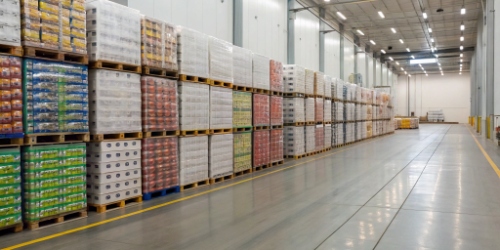
Is your frozen goods warehouse a chaotic mess? This disorganization costs you time and money. A smart pallet coding system can bring clear visibility and control back to your operations.
To optimize, assign a unique code to each pallet and link it to the product barcodes it holds. Use a system, like our WeigherPS, that visually maps pallet locations. This provides real-time tracking, simplifies searches, and turns your warehouse into a transparent, easily managed space.

Having a clear top-level answer is great, but the real challenge lies in the details. You might be wondering how this actually works in practice and what specific steps you need to take. Let's break down the best practices to transform your frozen product management from a source of frustration into a streamlined, efficient part of your business. We've seen it all in our 19 years of helping businesses like yours.
What Are the Best Practices for Arranging Frozen Product Pads and Warehouse Layouts?
Is your warehouse layout slowing you down? Inefficiently placed frozen goods can bottleneck your entire operation. A systematic approach to arranging pallets and designing your space is the solution.
Best practices include assigning unique IDs to each pallet, linking them to product data in a central system. Then, organize your warehouse layout logically—by product type, expiry date, or velocity—and use software to visualize this layout for quick access and efficient stock rotation.

The first step is establishing a solid foundation. In my experience, everything starts with giving each carrier, like a pallet or rack, a unique digital identity.
The Power of Unique IDs
Every single pallet must have a unique code, usually a QR code or barcode. This code acts as its digital license plate. When you place frozen products on this pallet, you scan the product barcodes and the pallet code. Our WeigherPS system then creates a direct link, knowing exactly what products are on which pallet. This simple act eliminates guesswork forever.
Strategic Warehouse Zoning
Next, you need a logical layout. Don't just place pallets wherever there's space. Plan your warehouse in zones. This strategy depends entirely on your specific needs. Here's a quick comparison of common zoning methods:
| Zoning Method | Best For | Key Benefit |
|---|---|---|
| By Product Type | Businesses with diverse inventory | Easy to find specific categories of goods. |
| By Expiration (FEFO) | Perishable goods like frozen food | Ensures older stock is used first, reducing waste. |
| By Velocity (ABC) | High-volume operations | Keeps fast-moving items near shipping for speed. |
By combining unique pallet IDs with a smart zoning strategy, you create a warehouse that is not just organized, but also highly efficient.1
How to Coordinate Segmentation Pad Codes with Warehouse Display Strategies?
You've coded your pallets, but your team is still lost? The disconnect between your digital codes and the physical warehouse layout can be frustrating. A visual display strategy is what's missing.
Coordinate codes by using a Warehouse Management System (WMS) that provides a real-time, visual map of your facility. When a pallet is moved, scan its code and new location. The system updates the map instantly, ensuring your digital display always matches the physical reality.

Having pallet codes is only half the battle. If your team can't use that information easily, it's not very helpful. This is where visual coordination becomes a game-changer.
Creating a Digital Twin
Imagine a map of your warehouse on a computer screen. This "digital twin" shows every rack, aisle, and designated pallet space.2 Our WeigherPS system turns this concept into reality. Each location in your warehouse gets its own barcode. When you move a pallet, you simply scan the pallet's code and then the code of its new spot. The system instantly updates the visual map, showing the pallet in its new position.
The Impact of Real-Time Visibility
This isn't just a fancy map; it’s a powerful operational tool.
- Find Anything, Instantly: Need to find a specific batch of frozen fish? A quick search in the system shows you exactly which pallet it's on and where that pallet is located on the map.
- Simplify Training: New employees don’t need to memorize complex layouts. They can just look at the screen.
- Error-Proofing Movements: The system makes it hard to put things in the wrong place. If a location is already full or designated for another product type, it can flag the error.
This coordination turns your warehouse from a confusing maze into a clear, navigable space.3
What Strategies Can Improve the Organization of Frozen Products and Warehouse Presentations?
Are your inventory counts still a massive headache? Manual stock-taking is slow and full of errors, costing you valuable time and resources. Leverage technology to make it fast and accurate.
Improve organization by using your management system for cycle counting and traceability. Instead of full physical counts, audit by pallet. Trace any product's complete history—from receiving to its current pallet location— with a simple scan, turning your warehouse into a transparent and auditable environment.

With a solid system in place, you can move beyond basic organization to truly strategic management. This is how you transform your warehouse into what I call a "transparent zone."
Smarter Audits with Cycle Counting
Forget shutting down your entire operation for a week to do a full physical inventory count.4 With a pallet-coded system, you can implement cycle counting. This means you audit small, manageable sections on a regular basis. Today, you might count the contents of five specific pallets. Tomorrow, a different five. The WeigherPS system allows you to select a pallet code and instantly see a list of what should be on it. Your team just verifies. This drastically reduces the workload and catches discrepancies early.5
Powerful Two-Way Traceability
This is where the real power lies. Our system provides full traceability in both directions:
- Pallet to Product: Scan a pallet's QR code, and you get a complete list of every item on it, including batch numbers and quantities.
- Product to Pallet: Search for a specific product's barcode, and the system instantly tells you which pallet it's on and shows you its exact location on the warehouse map.6
This level of control makes finding lost items, managing recalls, or checking stock levels an effortless task.
Conclusion
By assigning unique codes to pallets and using a visual WMS, you can transform your frozen warehouse, boosting efficiency, accuracy, and profitability. We can help you achieve this.
-
"Applications, Research and Visions for Smart Logistics Zones", https://www.sciencedirect.com/science/article/pii/S1877705817301017. Combining unique pallet IDs with zoning strategies is supported by operational efficiency studies in logistics. Evidence role: mechanism; source type: research. Supports: Combining unique pallet IDs with zoning strategies enhances warehouse efficiency.. ↩
-
"Digital Twins for Warehouse Operations", https://digitalsc.mit.edu/the-influence-of-dynamic-capabilities-in-digital-supply-chain-transformation/. The concept of a digital twin for warehouses is supported by industry reports on digital transformation in logistics. Evidence role: definition; source type: institution. Supports: A digital twin represents a virtual model of warehouse spaces, including racks and aisles.. ↩
-
"Development of an improvement framework for warehouse ... - PMC", https://pmc.ncbi.nlm.nih.gov/articles/PMC10112039/. Warehouse coordination through digital systems is shown to improve navigability, as supported by logistics case studies. Evidence role: case_reference; source type: research. Supports: Digital coordination systems improve warehouse navigability.. ↩
-
"Cycle Count vs. Physical Count: Key Differences & How to Choose", https://www.netsuite.com/portal/resource/articles/inventory-management/cycle-count-vs-physical-count.shtml. Cycle counting is a recognized alternative to full physical inventory counts, as documented in inventory management practices. Evidence role: mechanism; source type: education. Supports: Cycle counting eliminates the need for full physical inventory counts.. ↩
-
"What is an Inventory Cycle Count? - Acctivate", https://acctivate.com/what-is-an-inventory-cycle-count/. Cycle counting is shown to reduce workload and identify discrepancies early, according to inventory management studies. Evidence role: statistic; source type: research. Supports: Cycle counting reduces workload and identifies discrepancies early in inventory management.. ↩
-
"Warehouse Barcode System: 5-Step Setup Guide (2026)", https://camcode.com/blog/how-to-implement-barcodes-in-your-warehouse-a-step-by-step-guide/?srsltid=AfmBOooTbcjei1LYTDr964Ien_c3sBr9p6DLTLNW4obckizx0HeaYEhW. Barcode-based systems for product location are supported by logistics technology research. Evidence role: mechanism; source type: research. Supports: Barcode systems enable instant product location and mapping in warehouses.. ↩



Comments (0)