

Your business relies on accurate grading, but old methods cause profit loss. You are falling behind global competitors. It is time to understand and close this technology gap.
The main difference is precision. Advanced overseas slaughterhouses use ultrasonic scanners to analyze the internal muscle, fat, and bone composition for grading. In contrast, many domestic operations still rely on external measurements with rulers and calipers, which is less accurate.
We see this difference in technology every day. As a manufacturer of industrial weighing solutions for 19 years, we have worked with partners globally. We understand the pressure to modernize and the challenges that come with it. The gap between these two methods is not just about a single piece of equipment; it represents a fundamental difference in approach to quality, consistency, and profitability. But why does this gap exist, and what does it really mean for your business? Let's look deeper into how these systems work and what hurdles prevent wider adoption of newer technology.
How Do Overseas Slaughterhouses Use Ultrasonic Scanning for Grading Compared to Domestic Methods?
Are you still grading carcasses with calipers and rulers? This manual process is slow and inconsistent. It leads to disputes and lost revenue on premium products that are graded incorrectly.
Overseas, a trained operator moves an ultrasonic probe across key areas of the carcass. The device sends sound waves inside and reads the echoes to measure fat thickness and muscle depth. This objective data instantly generates a precise grade. Domestic methods are more manual and subjective.
To truly grasp the difference, we need to break down the two processes. It's a comparison between looking inside the product versus just measuring the outside of the box. The data you get from each method is completely different in quality and usefulness, especially for partners like software vendors who need reliable data streams.
The Ultrasonic Process
With ultrasonic scanning, the goal is to see what the customer will eventually buy: the meat. The scanner measures key indicators like ribeye area and backfat thickness with incredible precision.1 This data is fed directly into a computer system. The system then uses a set algorithm to assign a grade. The process is fast, repeatable, and generates digital records that are perfect for tracking and analysis.
The Traditional Process
The traditional method involves measuring the carcass at specific points. This might include the length of the body or the fat thickness at one single point with a ruler. This approach relies heavily on the skill of the operator and established correlations that may not apply to all animals. The data is often recorded manually, which can introduce errors and is much harder to integrate into modern software systems.
| Feature | Ultrasonic Scanning | Traditional Instruments |
|---|---|---|
| Method | Internal analysis | External measurement |
| Data Points | Muscle depth, fat layers | Length, width, single-point fat |
| Accuracy | High (measures meat directly) | Variable (relies on correlation) |
| Speed | Fast, automated calculation | Slow, manual process |
| Objectivity | High (machine-based) | Low (operator dependent) |
What Are the Advantages of Ultrasonic Scanning Over Traditional Measuring Instruments in Livestock Grading?
Inconsistent product grading damages your brand's reputation. When customers get a lower quality product than they paid for, they lose trust. There is a way to guarantee fairness and consistency.
Ultrasonic scanning provides objective, precise, and repeatable results. It removes human error and subjectivity from the grading process. This leads to fairer pricing for producers, higher quality for consumers, and much more valuable data for the entire supply chain.

When we talk to our partners, the conversation always turns to data. For a software provider, good data is everything. The advantages of ultrasonic scanning go far beyond just a better grade; they create a foundation for a smarter, more efficient operation. It's about moving from guesswork to data-driven decisions.
Unmatched Precision
The biggest advantage is accuracy. Ultrasound technology sees inside the carcass. It directly measures the amount of lean muscle and fat, which are the primary drivers of value. Traditional methods just estimate these values based on external size. This means you can identify and reward high-yield carcasses with certainty, maximizing the value of every animal.
Objective and Consistent Data
Humans make mistakes, especially when tired or rushed. An operator might measure slightly differently in the morning than in the afternoon.2 Ultrasonic scanners do not have this problem. They apply the same standard to every single carcass, every time. This consistency is critical for building trust with both suppliers and buyers. It also gives software systems a clean, reliable data stream to work with.
Increased Profitability and Insights
Accurate grading means you can price your products more effectively.3 You don't lose money by underpricing premium meat or overpricing lower-grade cuts. Furthermore, the detailed data collected can be analyzed over time. You can track genetic performance, optimize feed programs, and provide data-backed feedback to farmers.4 This transforms the slaughterhouse from a simple processing plant into a vital data hub for the entire industry.
Why Are Measuring Instruments Still Predominant in Domestic Livestock Grading Systems?
You want to upgrade your technology, but the cost seems too high. The path to modernization feels complicated and filled with risk. It's frustrating to know a better way exists.
The widespread use of traditional measuring instruments continues due to three main challenges. First, the high initial investment for ultrasonic equipment is a major barrier. Second, algorithms must be adapted for diverse local livestock breeds. Third, there is not enough historical data to train the systems effectively.
As a manufacturer with deep roots in the industry, we understand these problems are not trivial. They are real business challenges that require practical solutions. It's not as simple as just buying a new machine. The context of the local market, including its animals and its data infrastructure, is incredibly important.
Prohibitive Equipment Costs
High-quality ultrasonic scanners and the software to run them are expensive.5 For many slaughterhouses, especially smaller or medium-sized ones, this upfront cost is simply too high. When your margins are already thin, investing hundreds of thousands of dollars in a new system is a difficult decision, even if the long-term payoff is clear.
Challenges with Breed Diversity
Ultrasonic grading systems rely on algorithms.6 These algorithms are often developed and trained using data from specific breeds, like Angus or Hereford cattle common in North America. Domestic markets often have a much wider variety of local breeds with different body structures. An algorithm trained on one type of animal will not be accurate for another, requiring expensive and time-consuming recalibration and research.
The Data Gap
Effective machine learning requires vast amounts of data.7 To build an accurate grading algorithm, you need a large historical dataset that links ultrasonic images to actual carcass cut-out data. Many domestic regions simply lack this foundation of digitized, high-quality historical data. Without it, developing a reliable, localized grading algorithm is nearly impossible. This is a foundational problem that new equipment alone cannot solve.
What Innovations Can Help Domestic Slaughterhouses Transition from Measuring Tools to Ultrasonic Scanning?
Feeling stuck between outdated manual methods and expensive, complex ultrasonic systems? The jump seems too big, leaving you unable to improve efficiency and accuracy. There has to be a middle path.
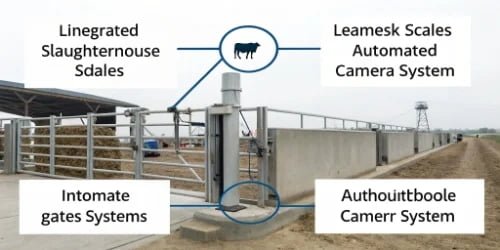
A fully automatic intelligent grading solution offers a practical bridge. This innovation combines advanced weighing scales, high-resolution cameras, and smart algorithms. It delivers a significant accuracy boost over manual tools without the extreme cost and data requirements of ultrasonic systems.

We believe the best solution is one that works in the real world, under current conditions. Instead of waiting for the "perfect" technology, we focused on creating the "most effective" technology for today. This is where our expertise in weighing and automation creates a new opportunity for our partners.
Introducing the Weigherps Smart Grading Solution
As an OEM/ODM manufacturer, we designed a system that leverages what is already available and enhances it with smart technology. Our solution starts with one of our high-precision industrial scales to get an exact weight. Simultaneously, cameras capture key dimensions and visual data of the carcass. Our proprietary algorithm then analyzes this combined information—weight, size, and shape—to produce a highly accurate grade. This is the most feasible domestic alternative available today.
Bridging the Technology Gap
This system is the perfect intermediate step. It is far more accurate and objective than manual rulers but avoids the high costs and data-dependency issues of ultrasonic scanners. It provides automated, consistent, and digitized results that can be easily integrated into your management software. We provide the reliable hardware and the foundational data stream; you, the software vendor, can build powerful applications and analytics on top of it.
A Partnership for the Future
We are not just selling a product; we are offering a partnership. We provide customized solutions to meet your specific market needs. Our system is designed for easy integration, and our 19 years of production experience ensures you receive stable, reliable hardware. For software companies looking to enter or expand in the smart agriculture and food processing space, we provide the dependable, tech-forward hardware platform you need to succeed.
Conclusion
The gap between overseas and domestic grading is real, but so are the barriers to entry. Our automatic intelligent grading solution bridges this gap, offering a cost-effective, practical leap forward.
- "Using live animal ultrasound measures of ribeye area and fat ...", https://pubmed.ncbi.nlm.nih.gov/2262403/. This source details how ultrasonic scanners measure ribeye area and backfat thickness, providing insights into their precision. Evidence role: mechanism; source type: research. Supports: Ultrasonic scanners measure key indicators like ribeye area and backfat thickness with high precision.. ↩
- "Evaluating the Reliability and Accuracy of Senior Veterinary ... - PMC", https://pmc.ncbi.nlm.nih.gov/articles/PMC12271826/. This source discusses the variability in manual livestock grading due to human factors, such as time of day and operator fatigue. Evidence role: expert_consensus; source type: research. Supports: Manual livestock grading can vary due to human factors like time of day and operator fatigue.. ↩
- "Possible Impacts of Changes in Usda Grade Standards and ... - NCBI", https://www.ncbi.nlm.nih.gov/books/NBK218179/. This source explains how accurate grading impacts product pricing, emphasizing its role in maximizing profitability. Evidence role: mechanism; source type: research. Supports: Accurate grading allows for more effective product pricing, leading to increased profitability.. ↩
- "Genetics and sports performance: the present and future in ... - PMC", https://pmc.ncbi.nlm.nih.gov/articles/PMC9012664/. This source discusses how data from livestock grading can be used to track genetic performance, optimize feed programs, and provide feedback to farmers. Evidence role: mechanism; source type: education. Supports: Data from livestock grading can be used to track genetic performance, optimize feed programs, and provide feedback to farmers.. ↩
- "A survey of barriers and facilitators to ultrasound use in low - PMC", https://pmc.ncbi.nlm.nih.gov/articles/PMC9969046/. This source provides an analysis of the costs associated with high-quality ultrasonic scanners and their software, highlighting financial barriers to adoption. Evidence role: statistic; source type: research. Supports: High-quality ultrasonic scanners and their software are expensive, creating financial barriers for adoption.. ↩
- "On-line pork carcass grading with the Autofom ultrasound system", https://pubmed.ncbi.nlm.nih.gov/9690641/. This source explains how ultrasonic grading systems use algorithms to analyze data, emphasizing their role in livestock grading. Evidence role: mechanism; source type: education. Supports: Ultrasonic grading systems rely on algorithms to analyze data for livestock grading.. ↩
- "From machine learning to digital twin integration for livestock ... - PMC", https://pmc.ncbi.nlm.nih.gov/articles/PMC12908607/. This source discusses the data requirements for effective machine learning, particularly in the context of livestock grading systems. Evidence role: expert_consensus; source type: education. Supports: Effective machine learning requires vast amounts of data, which is a challenge for developing localized grading algorithms.. ↩



Comments (0)