
Tired of losing money from inconsistent manual packing? When workers rely on their hands to measure, that "feel" changes, leading to costly product giveaway. It's time to replace guesswork with a guaranteed standard.
Yes, industrial scales can and should set the standard for packing. By turning "how much" into a clear number on a screen, the scale eliminates subjective judgment. When the scale says it's enough, it's enough, ensuring every package is consistent, accurate, and profitable.
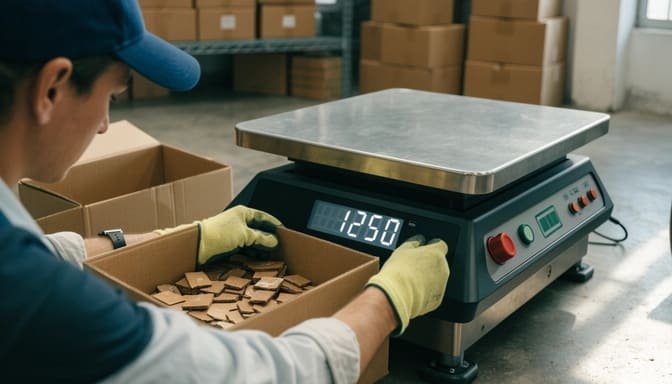
I've been in the weighing industry for nearly two decades, and I've seen this story play out time and time again. Companies put immense effort into production, only to lose profits at the final step: packing. A worker's "feel" is not a reliable business tool. It changes from morning to evening, from worker to worker. This inconsistency directly impacts your bottom line. The good news is that there's a straightforward, proven solution. It's about giving your team a better tool, and in this case, that tool is a reliable industrial scale. Let's explore how this simple change can create a powerful standard for your entire operation.
Can industrial scales be used to establish a standard quantity for manual packing by workers?
Struggling with package weights that are all over the place? This inconsistency, born from manual estimation, is a silent profit killer. What if you could finally enforce a uniform standard?
Absolutely. Industrial scales are the perfect tool to establish a standard quantity for manual packing. They provide a precise target weight that removes all guesswork, turning a variable process into a simple, repeatable task for any worker on any shift.
From Subjective Feel to Objective Data
The core problem with manual packing is that "feel" is subjective. I've seen it myself—a worker who is energetic in the morning might pack a little heavy, while the same worker, tired at the end of their shift, might pack light. As a business, you can't build a standard on such a moving target. An industrial scale replaces this subjectivity with cold, hard data. It provides a digital display that shows the exact weight in real-time. The task for the worker is no longer to guess but simply to match the contents to the number on the screen.
The Power of Checkweighing
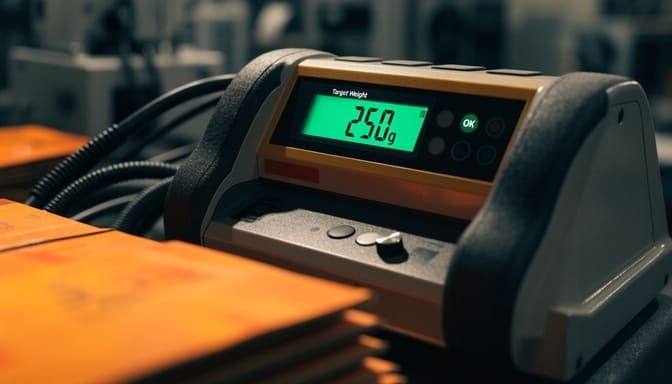
Many modern industrial scales, including our own, come equipped with a checkweighing function. This is a game-changer for manual packing. You can program a target weight, along with acceptable upper and lower limits. The scale then provides a simple visual cue—often a green light for "OK," a red light for overweight (HI), and another for underweight (LO)1. This transforms the process. The worker doesn't even need to read the numbers closely; they just pack until the light turns green. It's fast, intuitive, and incredibly accurate.
| Feature | Manual Feel Packing | Scale-Assisted Packing |
|---|---|---|
| Consistency | Low (Varies by worker and time) | High (Standardized across all operations)2 |
| Accuracy | Poor, leading to product giveaway. | Excellent, precise to the unit. |
| Efficiency | Slower due to hesitation and guesswork. | Faster, with clear start and stop points. |
| Profitability | Lower due to giveaway and potential shortages. | Higher due to minimized waste and accurate counts. |
| Training | Difficult, relies on intuition. | Simple, based on clear visual cues. |
Is it possible to set a packing standard using industrial scales when workers rely on tactile judgment?
Your team's hands are skilled, but relying on their judgment for weight is costing you. Every extra piece of product they pack is profit given away for free. There has to be a better way to control it.
Yes, an industrial scale makes it entirely possible to set a firm packing standard. The scale provides a clear, numerical target that overrides tactile judgment. This creates an enforceable standard that workers can easily follow and managers can easily trust.
Creating the "Golden" Standard
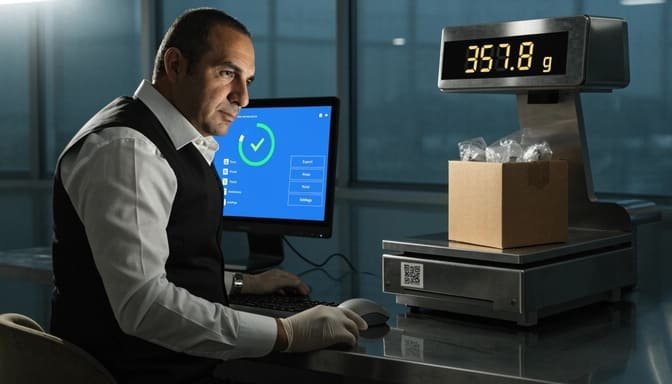
I once worked with a coffee roaster who was struggling with this exact issue. They sold premium beans in 1-pound bags, but their average bag weight was closer to 1.1 pounds. That 10% giveaway was costing them thousands of dollars each month. Our first step was simple: we took one of our bench scales, used the tare function to zero out the weight of the bag, and then set the target weight to exactly 1.00 pound. That became the "golden" standard. It was no longer an abstract idea; it was a number. The scale became the single source of truth for every package.
Turning Data into Action with Software
For you, as a software vendor, this is where it gets really interesting. Modern industrial scales are not standalone devices. They are data-output machines3. As a company specializing in OEM/ODM, we design our scales to be integrated. They can connect directly to your Warehouse Management System (WMS) or other software platforms4. This means you can do more than just set a standard; you can track it in real-time. Imagine a dashboard where a purchasing manager can see the average pack weight, the efficiency of each packing station, and the total material giveaway for the day. That’s the power you can unlock when you integrate our hardware with your software. It turns a simple scale into a business intelligence tool.
How can industrial weighing systems help standardize the amount packed by hand?
Is your manual packing process a black box? You hope for the best but often deal with inconsistent results and customer complaints. What if you could bring digital precision to this manual task?
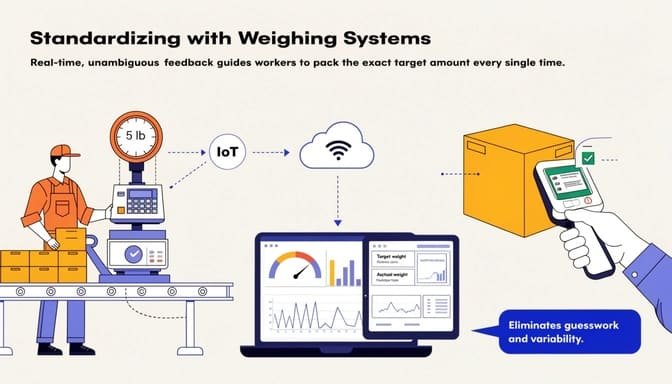
Industrial weighing systems standardize manual packing by providing real-time, unambiguous feedback. Through clear digital displays and alerts, they guide workers to pack the exact target amount every single time, completely removing guesswork and variability from the process.
More Than a Scale: A Complete System
First, let's be clear: we're talking about more than just a scale. We're talking about a weighing system. This includes the high-precision scale platform, a user-friendly indicator (the display), and, most importantly for you, connectivity. As an expert in industrial weighing, I know that the true value is unlocked when the scale communicates. Our systems are designed for this, with options for integration that allow them to talk to other machines and software. This is a huge opportunity for a software vendor. You can build a solution where our scale provides the raw, accurate weight data, and your software turns it into actionable insights for your customer.
The IoT Revolution in Weighing
This is where my team at Weigherps gets really excited. We specialize in IoT electronic scales. An IoT-enabled scale can send weight data directly to the cloud without needing a local PC.5 For your customer, the technical director, this is a dream. It means they can monitor packing lines across multiple locations from a single dashboard6. They can get alerts on their phone if a particular station is consistently over-packing. This moves quality control from a retroactive, on-the-floor task to a proactive, remote management function. It’s what we mean when we say we help our customers revolutionize conventional weighing.
| Feature | Standalone Scale | Integrated IoT Weighing System |
|---|---|---|
| Functionality | Displays weight locally. | Transmits weight data to the cloud. |
| Monitoring | Must be physically present. | Remote, from any device. |
| Data | Is lost after each weighment. | Is logged, stored, and analyzed. |
| Integration | None. | Connects to ERP, WMS, and custom software. |
| Business Value | Basic operational tool. | Strategic business intelligence asset. |
Can an industrial scale replace manual estimation and enforce precise packing standards?
Relying on "estimation" is just another way of saying you're gambling with your profits. Is your packing line a fine-tuned operation or a game of chance where you consistently lose?
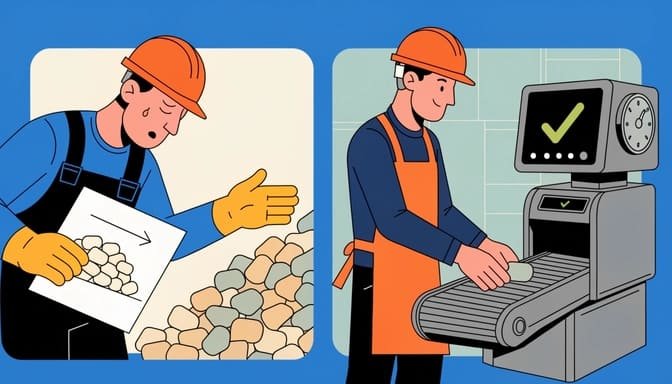
Yes, an industrial scale absolutely can—and should—replace manual estimation. It enforces precision by turning the abstract feeling of "enough" into a concrete number. This creates a non-negotiable standard that eliminates costly errors and drives consistency.
It's About Empowering the Worker
Let me share a perspective from my 19 years of experience: this is not about replacing the worker. It's about replacing their most unreliable tool—their subjective "feel"—with a perfectly reliable one. Think about the stress of guessing all day long. Workers are often afraid of under-packing and causing a customer complaint, so they "safely" over-pack, which costs the company money. An industrial scale removes that pressure. The scale makes the decision. My core insight is simple: "If the scale says it's enough, it's enough." This gives the worker confidence, makes their job easier, and turns them into a more efficient and accurate employee.
Meeting Compliance and Building Trust
For your customers in Europe and North America, this is about more than just cost savings. It's about compliance. Regulations around declared net weight are strict. An underweight package can lead to fines and legal issues. An industrial scale, especially one that is CE certified like our products, ensures that every package leaving the facility meets these legal requirements. When we provide a client with a weighing solution, we're giving them peace of mind. I remember a client in the packaged goods industry who was constantly worried about regulatory audits. After implementing our checkweighing scales, they a new slogan in their marketing: "Guaranteed Weight in Every Pack." They turned a compliance headache into a competitive advantage.
Conclusion
Stop letting subjective feelings dictate your profits. Industrial scales create a clear, enforceable standard for manual packing, reducing waste, ensuring consistency, and empowering your team with the right tools for a job well done.
-
"2023 NIST Handbook 44.pdf", https://www.nist.gov/system/files/documents/2022/11/30/2023%20NIST%20Handbook%2044.pdf. Technical descriptions of checkweighing identify limit indicators such as under, acceptable, and over tolerance signals, supporting the statement that visual cues can guide operators during weighing. Evidence role: definition; source type: institution. Supports: Checkweighing systems can provide visual indications for underweight, acceptable, and overweight conditions.. Scope note: The exact colors and interface vary by manufacturer, so the source would support the common function rather than the specific implementation on every scale. ↩
-
"Application of statistical process control in healthcare improvement", https://pmc.ncbi.nlm.nih.gov/articles/PMC2464970/. Quality-management literature on standardization and measurement-based process control supports that using objective measurements and defined tolerances can reduce process variation compared with uncontrolled manual judgment. Evidence role: expert_consensus; source type: paper. Supports: Using scales and defined tolerances can improve consistency relative to manual estimation.. Scope note: The source would support the quality-control principle, not prove the table’s qualitative rating for every packing line. ↩
-
"RS-232 weight indicator", https://www.directindustry.com/industrial-manufacturer/rs-232-weight-indicator-267344.html. Technical documentation and industrial-automation references describe weighing indicators and load-cell systems as capable of transmitting measurement data over digital or serial communication interfaces, supporting the claim that modern scales can output usable data. Evidence role: mechanism; source type: research. Supports: Modern industrial weighing devices can output weight data for integration with other systems.. Scope note: Connectivity is model-dependent; not all industrial scales include digital output or network interfaces. ↩
-
"Research on Intelligent Warehousing and Logistics ... - PMC", https://pmc.ncbi.nlm.nih.gov/articles/PMC8947898/. Research and logistics-system literature describes warehouse management systems as integrating data from shop-floor or warehouse devices, including identification and measurement technologies, supporting the contextual feasibility of connecting weighing data to WMS platforms. Evidence role: general_support; source type: paper. Supports: Industrial scales can be integrated with WMS or other software systems when compatible interfaces are available.. Scope note: The source would support integration in principle; direct compatibility depends on the scale interface, middleware, and the specific WMS. ↩
-
"Leveraging IoT, Cloud, and Edge Computing with AI - PMC - NIH", https://pmc.ncbi.nlm.nih.gov/articles/PMC11945247/. IoT literature explains that connected sensors can transmit measurement data to cloud services through network communication, supporting the plausibility of cloud-connected weighing devices as a class of IoT measurement systems. Evidence role: mechanism; source type: paper. Supports: IoT-enabled weighing devices can transmit weight data to cloud systems without relying on manual local recording.. Scope note: This is contextual support for IoT architecture; whether a scale bypasses a local PC depends on its embedded networking hardware and configuration. ↩
-
"Remote Monitoring & Telemetry Systems", https://www.iotintl.net/remote-monitoring. Industrial IoT and remote-monitoring research describes centralized dashboards for aggregating sensor data from distributed facilities, supporting the claim that connected weighing systems can enable multi-site operational visibility. Evidence role: general_support; source type: research. Supports: IoT-connected weighing systems can support remote monitoring of distributed packing operations.. Scope note: The source would support the remote-monitoring model generally, not verify the performance of any specific weighing product or dashboard. ↩



Comments (0)