

Manually calculating employee performance is tedious and often inaccurate. This creates tension and disputes. An automated system eliminates these problems, bringing fairness and transparency to your team's evaluations.
The most efficient way to calculate sorting employee performance is by using an automated system. This system automatically records key data like orders completed, weight sorted, and error rates. It then applies preset rules to calculate scores and pay, providing fair, data-driven, and transparent results.

I've been in the weighing industry for nearly two decades, and I've heard the same story countless times. A warehouse manager spends the last few days of every month buried in spreadsheets, trying to piece together who sorted what. The data is messy, the numbers don't add up, and employees are unhappy with the results. It's a frustrating cycle that hurts morale and productivity. But there is a much better way. Moving away from manual-entry spreadsheets and into an automated system is the single biggest leap you can make. Let's explore how this technology can completely change how you measure performance.
How Can Employee Performance in Sorting Operations Be Measured Using Technology?
Are you struggling to find objective ways to measure your team's work? Manual tracking is subjective and inconsistent. Technology offers a clear, data-driven path to fair and accurate evaluation.
Technology accurately measures performance by automatically tracking key performance indicators (KPIs). These include sorting speed, accuracy, total weight processed, and work duration. This provides objective data that forms the basis for fair performance reviews and compensation, removing guesswork and bias from the process.

To properly measure performance, you need to track the right things. Relying on just one metric, like the number of orders, can be misleading. A good automated system captures a balanced set of data points to give you a full picture of an employee's contribution.1 At Weigherps, we help our clients focus on the metrics that truly matter. It's about combining productivity with quality.
Core Productivity Metrics
This is the most direct measure of output. It answers the question, "How much work did the employee get done?" This can be tracked as the number of parcels sorted or the total weight of items processed. In my experience, using total weight is often a better indicator for industrial sorting, as it better reflects the physical effort involved.
Quality and Accuracy Metrics
Productivity means nothing if the work is done incorrectly. A critical KPI is the error rate. Our systems can log mistakes, such as a package being sorted into the wrong bin. Tracking this metric is essential for maintaining high service quality and identifying employees who may need additional training.
Efficiency Metrics
Efficiency measures how well an employee uses their time. This includes the total time spent logged into the system and the average time taken per task. By analyzing this data, you can set realistic benchmarks and spot inefficiencies in your workflow.
Here is a simple breakdown of these key metrics:
| Metric Category | Specific KPI | Why It's Important |
|---|---|---|
| Productivity | Total Weight Sorted2 | Reflects the physical workload and overall output. |
| Productivity | Orders Completed | Measures task completion and handling volume. |
| Quality | Error Rate3 | Ensures accuracy and minimizes costly mistakes. |
| Efficiency | Time Per Task / Order | Identifies speed and workflow smoothness. |
| Efficiency | Active Work Time4 | Differentiates active work from idle time for fairness. |
By tracking these KPIs together, you get a balanced and fair view of each employee's performance.
What Are the Best Tools for Tracking and Analyzing Sorting Staff Performance?
You know what to measure, but what tools should you use? The market is full of options, and choosing the right one can be a challenge. You need a solution that simplifies, not complicates.
The best tools are integrated weighing management systems. These solutions combine smart hardware, like IoT-enabled scales, with powerful software. They automatically capture data, analyze performance against your rules, and provide real-time dashboards and reports for easy management.

A few years ago, we worked with a software company that was developing a new warehouse management system (WMS). They had the software side covered but needed a reliable way to get accurate data from the warehouse floor. Their clients were complaining about the disconnect between the software's predictions and the actual physical work being done. This is where the right tools become critical. A complete solution isn't just about software; it's about the entire ecosystem, from the hardware that touches the package to the software that crunches the numbers.
The Hardware Foundation: Smart Scales
The starting point for accurate data is the hardware. Traditional scales that only show weight are no longer enough. You need smart scales equipped with scanners and connectivity. When an employee scans a package, the scale instantly records its weight, the employee ID, and the time. This information is the raw material for your entire performance system. As a manufacturer, we've spent 19 years perfecting industrial scales to be durable, accurate, and ready for integration.
The Software Brain: Management Systems
This is where the magic happens. A good performance management software takes the raw data from the smart scales and turns it into actionable insights. It applies your company's specific rules—for example, a certain pay rate per kilogram sorted or a bonus for achieving a zero-error streak. This is the "brain" that automates the calculations your managers used to do by hand.
The Integration Key: APIs and Connectivity
For our clients, especially software vendors, this is the most crucial part. A great tool must be able to communicate with other systems. Our systems are built with robust APIs (Application Programming Interfaces) that allow them to seamlessly connect with your existing WMS, ERP, or payroll software. This means our hardware can feed data directly into your software, creating a single, unified source of truth. Your system can then use this data without any need for manual import or export.
What Automated Solutions Can Streamline Performance Evaluation for Sorting Employees?
Your managers are spending hours in spreadsheets instead of on the floor coaching their teams. This manual work is slow, error-prone, and a drain on resources. How can you automate this entire process?
Automated solutions streamline evaluation by creating a hands-off workflow. The system captures sorting data in real-time, instantly calculates performance scores and compensation based on preset rules, and automatically generates detailed reports for both managers and employees.
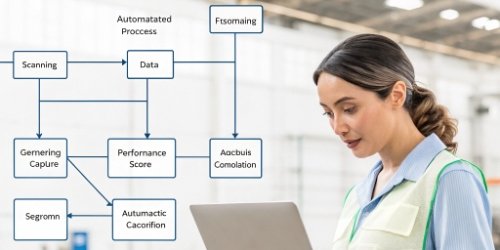
The goal of automation is to make the entire evaluation process effortless and transparent. A truly streamlined solution handles everything from the moment an employee starts their shift until their performance report is in their hands. I remember visiting a client's facility after they implemented one of our integrated systems. The warehouse manager told me he got two days of his month back. That's the power of a streamlined, automated workflow. Let’s walk through what that looks like.
Step 1: Automated Data Capture
It all begins on the floor. An employee scans an item, places it on the Weigherps smart scale, and sorts it into the designated location. At that moment, our system automatically captures a rich set of data: the employee's ID, the item's weight, the timestamp, and the sorting decision. There is no manual logging, no writing on a clipboard, and no room for human error. The data is clean, accurate, and captured instantly.
Step 2: Rule-Based Performance Calculation
This is where your business logic comes into play. Within the system, you configure the rules for performance. For example, you might set a base rate per kilogram, with bonuses for exceeding a certain tonnage per hour, and penalties for errors. As the data flows in, the system automatically applies these rules in real-time. It calculates each employee's score and earnings throughout their shift, without any manual intervention.
Step 3: Transparent Reporting and Feedback
Transparency is the key to employee buy-in. An automated solution provides clear, accessible reports. Managers can view team and individual performance on a live dashboard. More importantly, employees can often see their own real-time statistics on a monitor at their station or through a portal. When payday comes, there are no surprises. The reports are fair, based on objective data, and directly tied to the work they performed. This simple step virtually eliminates pay disputes and builds a culture of trust and motivation.
Conclusion
Automating performance calculation saves time, ensures fairness, and boosts team motivation. It is a clear path to a more efficient and profitable sorting operation.
-
"[PDF] Measuring Employee Performance – A Supervisor's Quick Guide", https://piv.opm.gov/policy-data-oversight/performance-management/performance-management-toolkit/best-practices/measuring-employee-performance-quick-guide.pdf. This source discusses the importance of capturing multiple data points for a comprehensive view of employee performance. Evidence role: expert_consensus; source type: institution. Supports: Automated systems should capture multiple data points for comprehensive employee evaluations.. Scope note: The source may focus on specific industries or metrics. ↩
-
"The Comprehensive Guide to Weight Sorting Machines | Easyweigh", https://www.easyweigh-group.com/blogs/weight-grader/the-comprehensive-guide-to-weight-sorting-machines/. This source explains why total weight sorted is a key metric for measuring physical workload in industrial sorting. Evidence role: definition; source type: encyclopedia. Supports: Total weight sorted is a key metric for measuring physical workload in sorting operations.. Scope note: The source may focus on industrial settings, limiting its relevance to other sectors. ↩
-
"Top employee performance metrics to track - HiBob", https://www.hibob.com/blog/employee-performance-metrics/. This source highlights the role of error rate as a critical KPI for maintaining service quality in sorting operations. Evidence role: definition; source type: education. Supports: Error rate is a critical KPI for maintaining service quality in sorting operations.. Scope note: The source may not address error rate tracking methods comprehensively. ↩
-
"[PDF] The Usefulness of Performance Reviews", https://harbert.auburn.edu/binaries/documents/center-for-ethical-organizational-cultures/debate_issues/performance-review.pdf. This source explains how active work time differentiates productive hours from idle time in employee evaluations. Evidence role: definition; source type: research. Supports: Active work time is a key metric for differentiating productive hours from idle time in employee evaluations.. Scope note: The source may focus on specific industries or use cases. ↩



Comments (0)